Letters from Tokyo #9 A Hidden Rule That Shapes Everyday Life
Surface Impressions
Japan has a reputation for politeness.
For many visitors, it’s one of the defining impressions — the order, the quiet, the sense that everyone is aware of everyone else. There’s an expectation that this politeness extends evenly, creating a kind of shared social warmth.
And often, it does.
But not always in the way people expect.
A recent video circulated online showing a woman at Shibuya Crossing violently shoulder barging a young tourist. It was jarring to watch — not because behaviour like that doesn’t exist elsewhere, but because it seemed so out of step with the image many people have of Japan.
But, if you spend enough time here, moments like that — usually far smaller, less dramatic — begin to surface.
Not hostile, exactly. Passive aggressive - sure. But not what you were expecting either.
It can feel, at first, like a contradiction.
How can a society so attentive to detail, so careful in its public behaviour, also produce moments that feel — to an outsider — surprisingly cold?
The Rules you Don’t See
The answer, I’ve come to realise, lies in rules that are rarely explained, beyond cursory sentences in a guide book.
Japan runs on a set of expectations most people never see.
Not the written ones — those are everywhere, clear enough if you know where to look. I mean the invisible framework that governs space, sound, order, politeness. The things no one explains to you, because explaining them would defeat their purpose.
You don’t learn these rules from guidebooks. You absorb them slowly — usually after getting something wrong, or after something forces you to stop and notice.
Or, sometimes, after something jolts you into seeing them clearly.
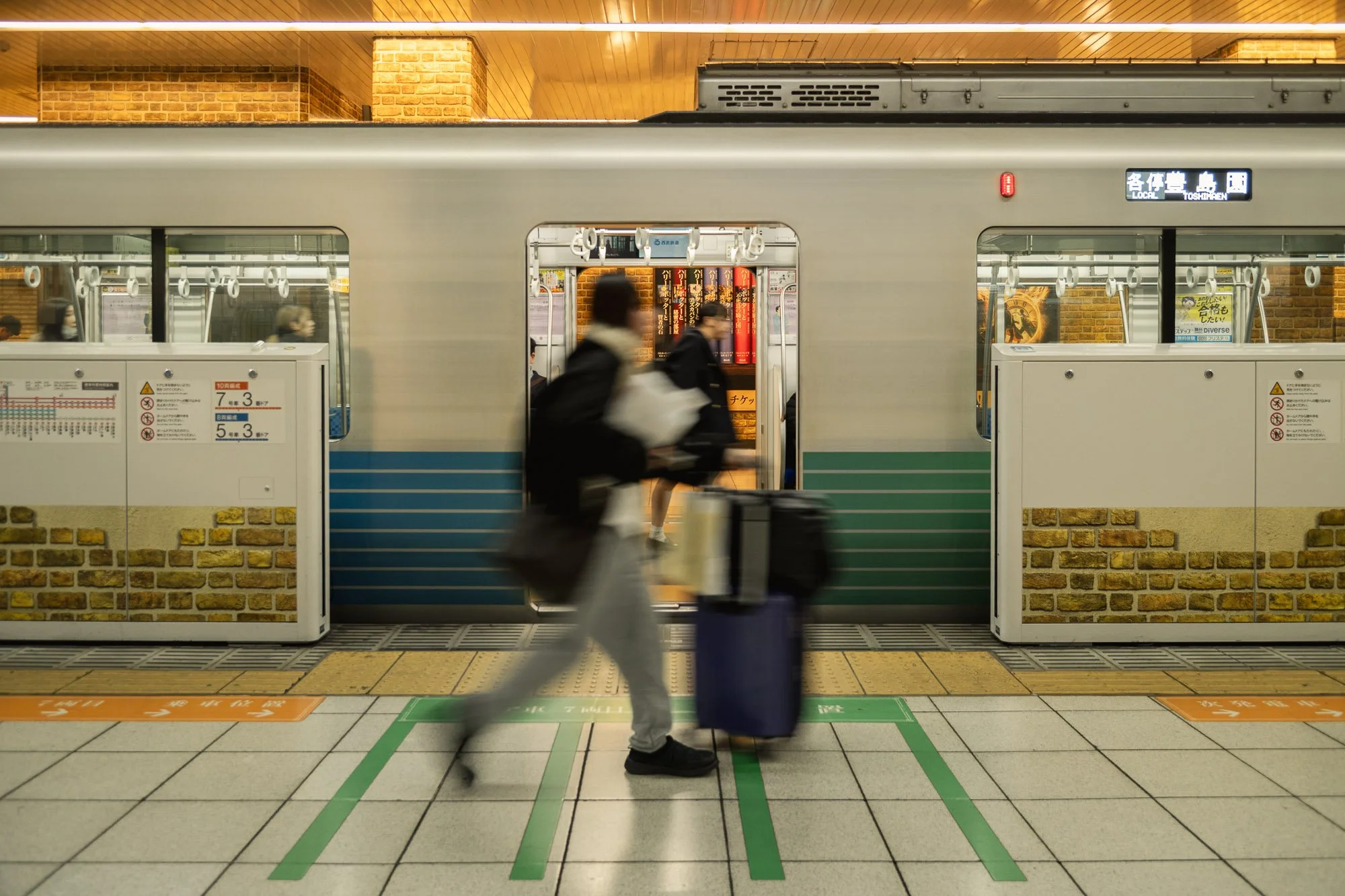
One evening, about 15 years ago, on a crowded train, I was riding home from work with a colleague and friend. The carriage was full. Everyone was speaking quietly. We were standing, holding the straps, talking in low voices — no louder than anyone else. We were observing social etiquette.
Everything was fine.
In front of us sat a group of young, suited and booted office workers, also in quiet conversation. Suddenly, one of them stood up to offer his seat to a senior colleague standing by the door. That’s normal. Nice, even.
However, he stood up with such force that he barged straight into me, sending me bowling over onto the laps of the people standing AND seated opposite.
There was no apology. No glance. No acknowledgement of my very existence.
In the moment, I was furious — livid. On the verge of kicking up a scene. Yet, the people onto whose laps I had been unceremoniously dumped hardly flinched, beyond helping me back on to my feet.
And that’s when it clicked.
It wasn’t personal, I - a complete stranger to the young man - simply didn’t register.
His attention was entirely on his ‘uchi’ (insiders) — on ensuring his senior was seated. The disruption caused to strangers, to ‘soto’ (outsiders), barely registered. It wasn’t personal. It was structural.
Understanding that didn’t make it acceptable. It’s still not acceptable to me all these years later. I still believe courtesy should apply outwards as much as inwards. But Japan doesn’t distribute consideration evenly. Priority often flows toward insiders - ‘uchi’ - first.
When It Starts to Make Sense
That moment reframed a lot of what I’d been noticing.
Japan values harmony, but harmony isn’t universal. It’s directed. It depends on who you’re responsible to, who you belong with, and who sits outside that circle.
Once you start to see that, patterns that once felt inconsistent begin to align.
The same awareness that keeps train carriages orderly and interactions predictable isn’t evenly applied in all directions. It flows inward first — toward colleagues, seniors, family — and only then outward, to ‘soto’.
That doesn’t mean courtesy toward outsiders doesn’t exist at all. It does, and often visibly so. Seats are offered to the elderly or frail. Space is made. People adjust themselves to avoid causing trouble or discomfort.
But these moments tend to occur where expectations are shared and clearly understood — where roles are defined; on trains, around priority seating, for example.
When those signals are less clear, attention can narrow. Not out of hostility, but out of focus.
And that distinction matters.
In a city as dense as Tokyo, that distinction serves a purpose. When trains are packed and movement is non-stop, you’re brushing up against strangers all the time — being nudged, blocked, squeezed, redirected. If every small disruption were taken personally, the system would grind to a halt; it would be exhausting.
That’s not to say conflicts never happens. They do — I’ve seen some myself. But they’re rare, especially for a city of this scale and magnitude.
The unspoken understanding is that most of it isn’t about you. It’s situational. And that assumption — that friction is structural, not personal — is what keeps things moving.
It explains why Japan can feel, at the same time, both deeply considerate and quite distant. It also explains why striking up conversations with complete strangers — something that feels natural, even easy, in places like London or New York — is far less common here.
It explains how someone might feel able to shoulder barge a stranger at a busy crossing without a second thought.
It’s also worth saying that the idea of soto and uchi is slowly starting to fade away...
As more people come into daily contact with foreigners — through work, travel, relationships, or simply through the sheer volume of tourists visiting Japan each year — the sharpness of the divide is softening in places.
You see it in small ways. A pause. A recalibration. A moment where someone hesitates before defaulting inward, aware that not everyone around them is reading the same signals.
The framework is still there, but it’s negotiated more often now, in real time.
Once you understand this, a lot else begins to make sense.
Not everything — but enough to move through the country with a little more awareness, a little less confusion, and a lot more confidence.
Sincerely,
Ross Harrison - A Tokyo-based photographer documenting a more authentic Japan beyond social media posts and postcards.