Letters from Tokyo #12: Come on England!
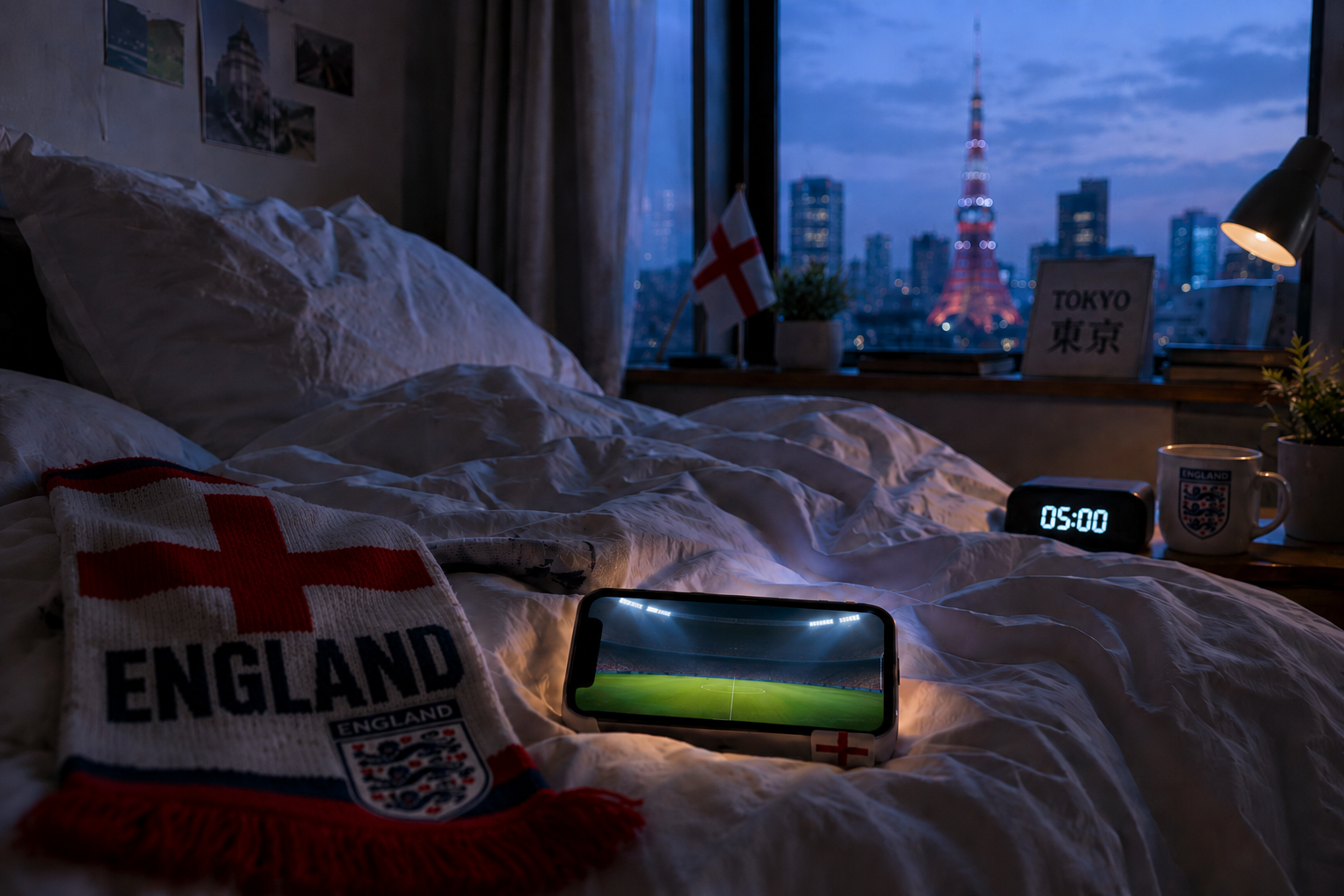
Supporting England is never easy, but it is even more difficult on the wrong side of the clock!
There are many ways to measure how long you have lived abroad.
You can count the years, obviously. You can count visa renewals, apartments, tax forms, earthquakes, typhoons, and the number of times you’ve accidentally bowed while speaking English.
Or, if you are English, you can count World Cups.
I arrived in Japan in 2003, which means that for more than two decades now, I have watched England from the wrong side of the clock.
This is one of the less glamorous parts of supporting a European football team from Japan. The World Cup may be a global event, but time zones are not. A perfectly reasonable evening kick-off in Europe becomes, for us, something ridiculous like 3:00 or 4:00 in the morning.
And yet, in those early years, I did it willingly.
In 2004, during the Euros, I sometimes took the last train into Shinjuku with colleagues from work and watched games in a sports bar. This was still when the whole thing felt like an adventure. We were younger, less sensible, and more easily persuaded that staying out all night to watch England was a good use of a weekday.
There is something very particular about Shinjuku after the last train has gone. The city changes shape. The people left behind are either committed to the night, stranded by it, or too proud to admit they have made a terrible logistical decision.
I was definitely all three.
By 2006, I was watching the World Cup with Ayako. Again, there was optimism. Proper optimism. The kind only England fans can produce, despite decades of evidence suggesting we should know better.
I would set the alarm, try (and fail!) to go to bed early, wake up bleary eyed in the dark, and tell myself this was all part of the magic.
Then England would start playing.
That was usually where the magic started to wear off.
One night during that tournament, Ayako and I went into town to watch a 3:00 a.m. kick-off. There were other English people in the pub too, all of us performing the same act of questionable devotion.
The game itself was a turgid affair. On paper, it was the kind of match England should have won easily. Needless to say, they didn’t.
After the final whistle, one of the other English fans looked genuinely offended.
“So rude,” he said. “We stay up all night on a workday to support this team, and they repay us with that crap.”
I never forgot that.
Yes, it was funny, but it was also hard to argue with.
There is a special kind of misery in waking up at 4:00 in the morning to watch your national team pass the ball sideways with no visible plan. It is bad enough when they ruin your evening. It is another thing entirely when they ruin your sleep before the day has even begun.
Watching England from Japan is not simply a question of loyalty. It is a question of scheduling. Do I go to bed early? Do I stay up? Do I sleep for three hours, watch the match, then crawl back into bed pretending that will somehow count as rest?
And if it is a workday, you’ve not just watched a game of football, you’ve sabotaged a Wednesday!
By 2010, I finally started to realise that supporting England from Japan was less a patriotic obligation than a sleep disorder.
But the excitement would still come. That was the annoying thing. Even when you knew better, even when all your adult instincts told you not to believe, some small, foolish part of you would begin to stir.
Maybe this time.
It wasn’t.
By 2014, expectations were low enough to be almost healthy. There was no grand feeling that destiny was waiting for us. No golden generation mythology. No real sense that this was going to be the year.
But the games were at more reasonable times, so we watched.
Sometimes that is all football asks of you.
Not hope. Just attendance.
As for 2012, I barely remember watching it. That probably says enough. And 2016 was diabolical, the kind of tournament that makes you wonder whether emotional distance is not only sensible, but necessary.
By the time 2018 came around, I was older, supposedly wiser, and much less willing to destroy my sleep schedule for England. In fact, I missed the first couple of kick-offs.
My wife, however, had other ideas.
Ayako is Japanese, but in our house she is now the more enthusiastic World Cup viewer. She would wake up, quietly reach for her phone, and watch England matches in bed while I remained in a state of heroic unconsciousness beside her.
This is one of the great surprises of married life abroad. You move to another country, build a life, become a permanent resident, learn how things work, pay taxes, renew documents, navigate systems, and then one morning discover that your Japanese wife is more committed to watching England at dawn than you are.
But then 2018 became dangerous.
England, inconveniently, started winning.
I had originally not planned to care.
Then I did.
That is the trouble with England. They do not need to do much to pull you back in. A decent run. A late goal. A likeable squad. A song everyone starts singing half as a joke and half because they desperately want it to be true; you know the one.
And suddenly there you are again, emotionally involved against your better judgement.
In 2022, the excitement was real too, but it was cut short by France, who would go on to reach the final. That one hurt because England were not hopeless. Sometimes that is worse. There is a strange comfort in being obviously terrible. There is no comfort at all in being close.
And now here we are again - FIFA World Cup 2026.
Yesterday morning, I woke up at five and watched England beat Croatia 4–2.
Five in the morning. In Tokyo. After all these years.
Apparently, I still care.
People are often surprised to learn that after all this time in Japan, I have not relinquished my British citizenship. Perhaps they assume that after this long abroad, nationality becomes something softer, more symbolic, less active. But when it comes to football, the feeling is not really British.
It is English. Irrational, familiar, and apparently still very much alive.
Yes, I am a permanent resident. Japan is my home. My life, marriage, work and dogs are here.
And yet, when England play football, something very old and very simple switches on.
For ninety minutes, there is no nuance. No careful reflection on identity, migration, home, distance, or cultural belonging.
There is just England, making life unnecessarily stressful.
And me, in Tokyo, making terrible sleep decisions because, against all available evidence, because they might - they just might - be good…
Come on England!
Sincerely,
Ross Harrison - A Tokyo-based photographer documenting a more authentic Japan beyond social media posts and postcards.