Letters from Tokyo #6 - Japan’s Tourism Surge: A Personal View
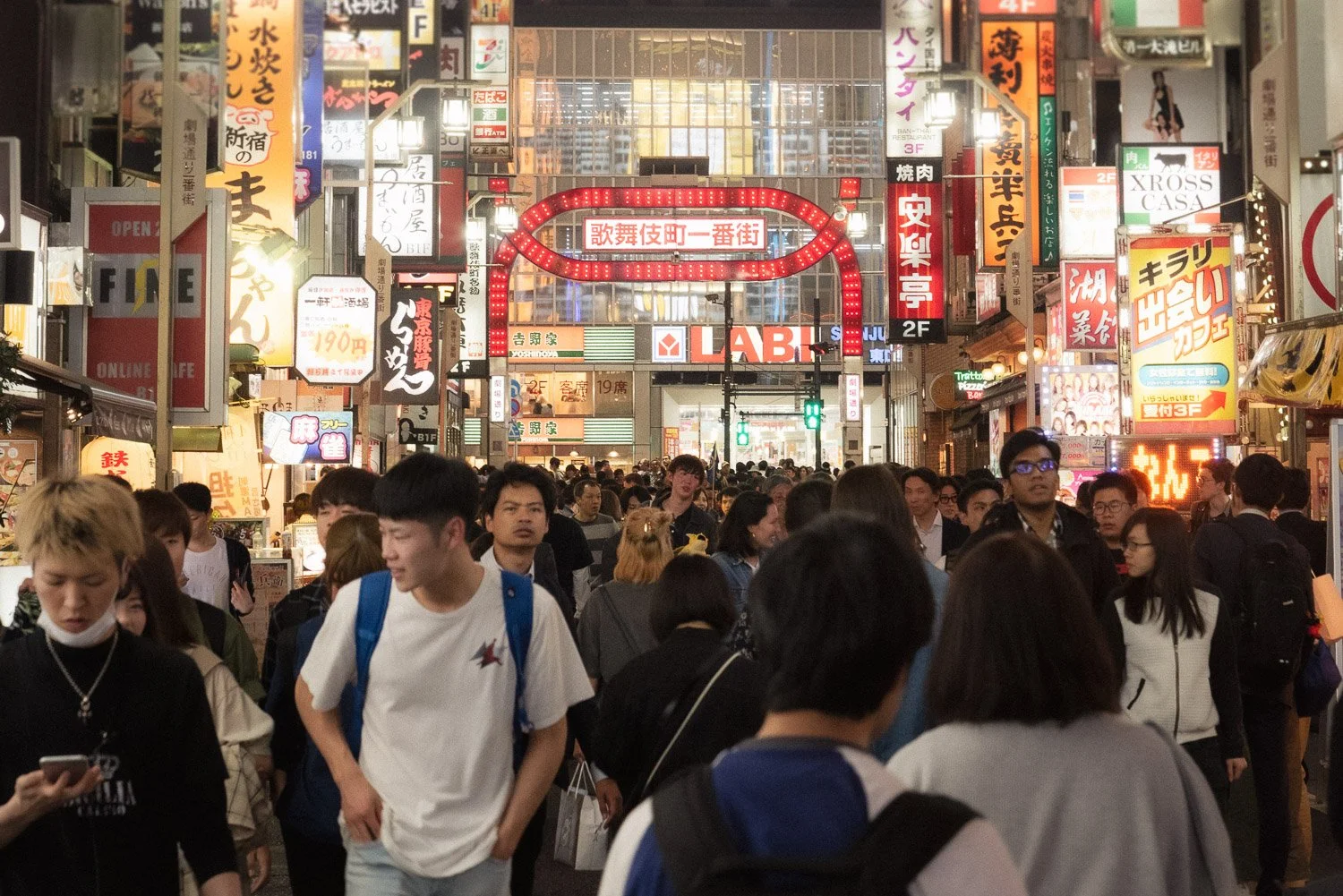
There’s no point pretending otherwise: we’ve all noticed it.
Not in headlines or government briefings, but on foot, on trains, and in the small frictions of daily life that only register when you’ve been here long enough to remember something different.
For years, my wife and I had a ritual. Once a year, usually sometime in the first quarter, we’d escape to Kyoto for a week. No itineraries. No highlights. Just walking and chilling. Kyoto back then felt expansive and unhurried. Even the famous places allowed space. It was calm in a way that felt almost deliberate. We could relax and disconnect. It was bliss.
Then for a few years, as work commitments got in the way, we were unable to go.
When we returned in autumn 2017, the contrast was brutal. Ninenzaka was no longer a street you walked up — it was a slow, collective shuffle, packed shoulder to shoulder, waddling like penguins toward Kiyomizu-dera. Fushimi Inari was the same. Not contemplative. Not spiritual. Just congested. The experience wasn’t enhanced by popularity; it was actually flattened by it.
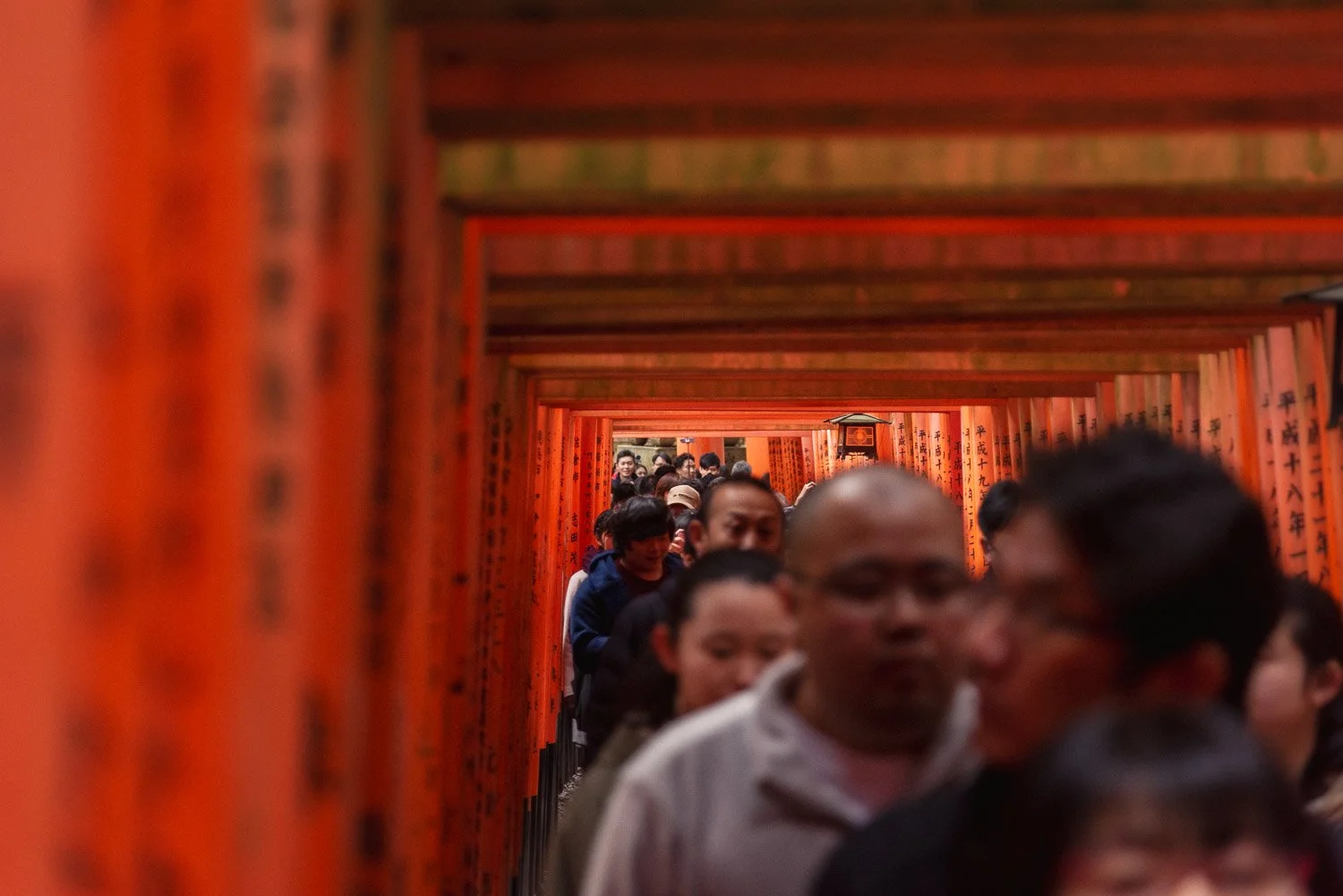
Tourist shuffling through the torii gates at Fushimi Inari Shrine, Kyoto
Then came COVID.
Less than eighteen months after launching Elope in Japan, tourism disappeared. In 2021, at the heart of the pandemic, we had one wedding in Kyoto. One. Yet, for that day, the city felt like it had been returned to itself. Empty streets. Open air. Silence. It didn’t feel eerie, it felt natural.
Yet, it was an uncomfortable gift. It was a reminder of how much of Japan’s beauty relies on space, stillness, and restraint. Kyoto without crowds did not feel hollow. It felt natural.
Then the restrictions lifted.
When borders reopened, things returned. Slowly at first. For a while, early morning shoots in Ninenzaka were possible. Dawn light. Closed shutters. A brief truce before the day began. But with each visit, the window of opportunity narrowed. More people. Earlier arrivals. Less tolerance.
Then came the tension.
Tourists pushing cameras into shop doorways. Lenses being aimed through private windows. Faces photographed at arm’s length without permission. Litter where there had been none. Noise where there had been silence. It became clear that we couldn’t pretend neutrality. As photographers or elopement planners, we were either part of the solution — or part of the problem.
So we stopped actively encouraging shoots in the old streets of Ninenzaka. Not because it isn’t beautiful - it is incredibly beautiful - but because beauty divorced from context turns into exploitation.
Tokyo tells the same story, just on a different scale.
Sensō-ji in Asakusa is now heaving, every single day. It’s no longer a place you pass through on the way to somewhere else; it’s a bottleneck. The temple still stands, unchanged, but the atmosphere has shifted. What was once a neighbourhood anchor now feels like a permanent stage set - or even theme park attraction - crowded from morning to night.
Even Ikebukuro — where we once lived — has transformed. In recent years it has become a magnet for anime tourism. A large Pokémon Center has opened in Sunshine City, attracting a new kind of visitor. Tourists now arrive in numbers that would have been unthinkable when we lived there.
Ikebukuro was once a place for locals to shop, to eat, to meet friends or to date. Now locals are jostling for space alongside visitors, navigating crowds in streets and malls that were never designed to carry this kind of attention. It’s not hostile. But it is different.
The change is visible even on the trains.
When I first arrived in Japan, I might have been the only foreigner in a carriage. People would glance, sometimes stare. The seat next to me was often left empty, even in rush hour - a phenomenon known as the “gaijin seat.” Not anymore. Now the carriage is international. European languages, Chinese, Korean, Vietnamese. Admittedly, these are not all tourists, but also students from South East and South Asia — living, studying and building lives here.
No one bats an eyelid anymore.
In many ways, this is progress. Tokyo is more open, more diverse, more outward-facing than when I arrived in 2003. But it also means the invisible social buffers Japan once relied on — distance, discretion, unspoken rules — are under strain.
Local complaints have grown louder. Bad behaviour on public transport (you’ve seen the videos). Disrespect at shrines and temples. A creeping sense that Japan is being treated less like a living society and more like a backdrop. Some locals have been opining that “tourist view Japan as their own personal Disneyland.”
That’s when irritation turned into real concern, and in some quarters, anger.
Now the government is responding — restrictions, barriers, fines. Some call them heavy-handed. Others say they’re overdue. But the debate often misses the central issue.
Japan doesn’t have an overtourism problem.
It actually has a distribution problem.
In 2024, Japan welcomed 36.87 million international visitors. A large number — until you compare it with France, which regularly attracts around 100 million tourists a year. The difference isn’t volume. It’s concentration.
Most visitors funnel into the same few places: Tokyo, Kyoto, Osaka, Hiroshima. Meanwhile, vast parts of the country remain overlooked, under-visited, and economically fragile.
If even a fraction of that traffic spread outward—across regional Japan—these conversations would sound very different. Pressure would ease. Friction would soften. Tourism benefits would finally match its cost.
This is where creatives have a responsibility.
Planners. Photographers. Writers. Anyone who makes a living framing Japan for others.
The job isn’t to sell Japan more loudly.
It’s to represent it more carefully.
That means resisting the urge to funnel everyone toward the same images, the same streets, the same angles. It means sometimes saying no (even if it hurts) — to a location, to a trend, to a photograph that looks good online but takes something away on the ground.
Japan still has moments of untouched quiet. They exist every day, often just a few streets over from spots made famous on social media. In residential neighbourhoods. In small towns. In places without geotags.
Those moments don’t need exploiting.
They need protecting.
And perhaps that is what Letters from Tokyo is really about — not nostalgia, and not complaint, but observation. Paying close enough attention to notice what is changing, what is being lost, and what is still quietly holding on. Because once you’ve lived here long enough, you realise that what makes Japan extraordinary is also what makes it fragile.
Sincerely,
Ross Harrison - A Tokyo-based photographer documenting a more authentic Japan beyond social media posts and postcards.