Letters from Tokyo #5: How Japan Has Changed Since 2003
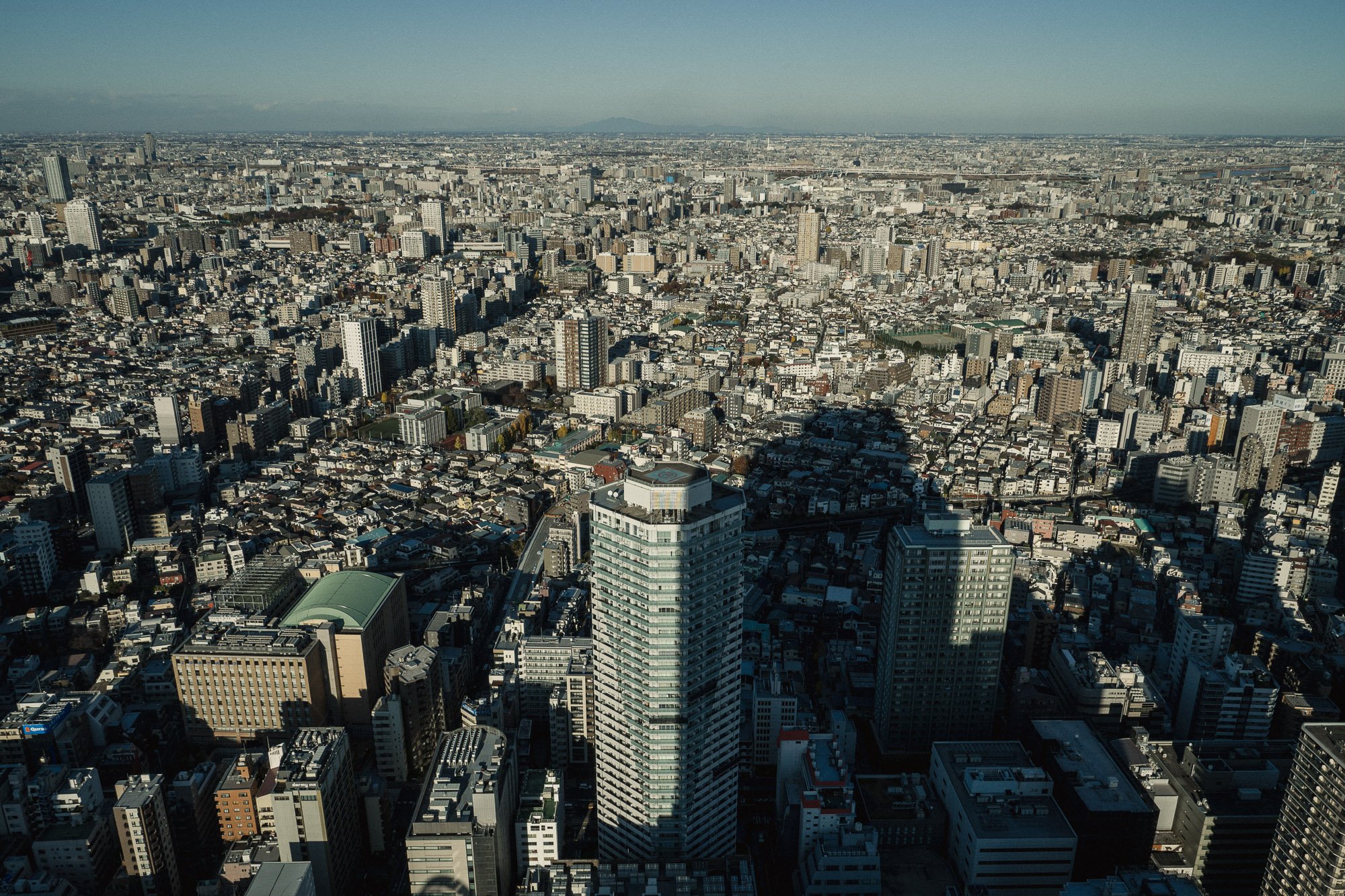
The high-rise in Ikebukuro, where Tokyo first began to shift under my feet, sometimes literally!
When I arrived in Japan in 2003, I didn’t come looking for a new life. I came for the experience — a year, maybe two — without imagining the country would shift under my feet, or that I would shift with it.
Back then, Japan felt firmly anchored in the analogue world. People clung to cash with white-knuckled conviction. Flip phones ruled the world, and were the envy of it. ATMs had operating hours — even shutting down entirely for four days over the New Year holiday. Daily life ran on habits that felt immovable, accepted without question.
And yet Tokyo pulsed with a sense of the future. Monorails, Galápagos-era mobile phones (developed in near isolation and on a whole different level), heated toilet seats, world-class railways; consumer technology that felt years ahead of anything I had grown up with in the 1980s and 90s. All of it coexisted with daily routines that remained firmly rooted in the past.
But permanence is an illusion.
Stay long enough and the seams begin to reveal themselves.
In 2007, Ayako and I moved into a flat on the 16th floor of a brand-new high-rise in Ikebukuro, with commanding views across the city. From that height, Tokyo felt enormous but strangely intimate. It was a place that rewarded wandering: full of rough charm, and, at the time, almost untouched by tourism. It was our neighbourhood, our playground, our vantage point.
And from that balcony, we watched something improbable take shape.
First, a thin metal silhouette on the horizon.
Then a growing framework.
Then, month by month, year by year, Tokyo Skytree rose into being - completed in 2012.
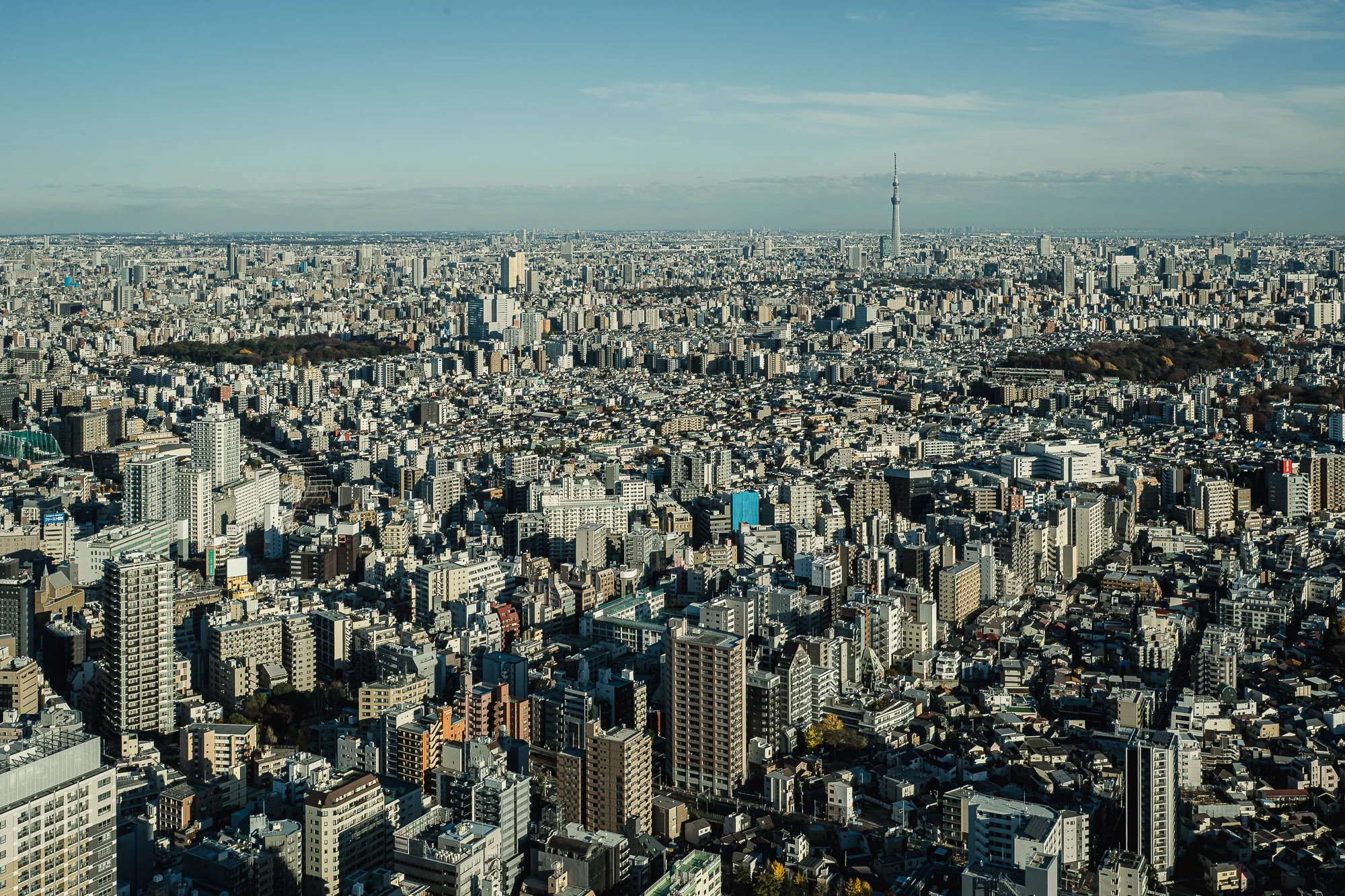
Tokyo Skytree, a marker on the horizon, as seen from high above the streets of Ikebukuro.
Watching a landmark appear from scratch is a quiet lesson in how cities really change — slowly, steadily, almost imperceptibly. And as the skyline shifted, so did everything beneath it. The slightly scruffy Ikebukuro I once had almost to myself gradually became a magnet for pop-culture tourism. The very backstreets I used to wander alone are now filled with anime fans, collectors, influencers, and people chasing a version of Tokyo they most likely first encountered online.
The neighbourhood didn’t just get busier; it took on a different identity altogether.
Looking back, Skytree became a kind of watershed for me — not because the tower itself transformed Japan, but because so many other changes seemed to coincide with it. By the time it stood complete on the skyline, the country already felt different underfoot.
Before that moment, Japan still felt largely inward-looking. Tourism was modest, reserved mostly for the adventurous. Flip phones were everywhere. Loyalty to one employer was expected, unquestioned, and often unrewarded. English teaching — my first job here — was widely seen as a springboard. You could rent an apartment, go out, save a little, or even a lot if you were careful — and single.
Now, for many, it feels more like a trap.
Wages stagnated. Contracts shrank. Teaching would eventually slide quietly into what is now regarded as “working poor” territory.
Around the same time I that moved to Ikebukuro, I also moved into headhunting, with an eye toward broadening my experience before possibly heading home to the UK. It was as a headhunter, (or rather “executive search consultant” as we affectionatley referred to ourselves), that I saw firsthand just how rigid Japanese work culture still was.
I met brilliant candidates rejected instantly simply because they had changed jobs twice in a decade. Loyalty wasn’t just valued; it was compulsory.
Now, in 2026, even that certainty has loosened.
Not suddenly.
Not dramatically.
But unmistakably.
Younger workers now talk openly about wanting better hours, better working conditions, better balance. In the early 2000s, admitting that out loud felt positively rebellious.
That loosening didn’t stop at work. It crept outward into daily life in smaller, quieter ways that were harder to ignore.
For my first decade in Japan, cash wasn’t just common — it was the foundation of the social contract. Bills were paid at convenience stores. Wallets bulged with paper currency. Digital payments were treated with suspicion, if they were acknowledged at all: card payments were a rare thing.
Then, almost without fanfare, everything shifted.
Apple Pay. PayPay. Suica. QR codes taped to every counter. Even older shop owners — the ones who once treated electronic payments like a threat — now wave the scanner across your phone with the confidence of seasoned pros. Cash is still here, but it no longer defines how life works. And wallets seem much thinner and lighter!
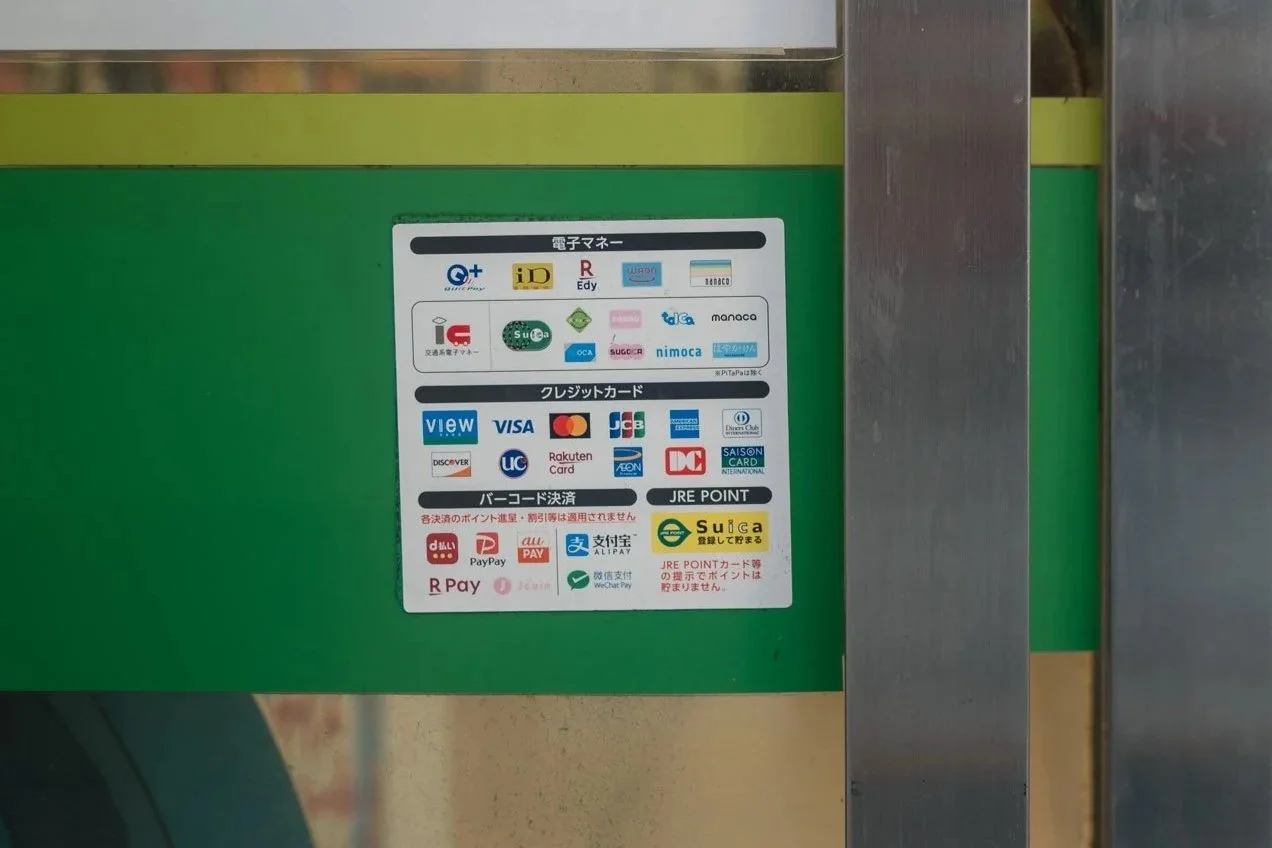
In 2003 cash was king - now the number of payment options has exploded.
The same recalibration shows up elsewhere. Hierarchies feel less suffocating. Language is more casual. Tattoos provoke less alarm. Younger generations don’t reject tradition outright — they just don’t inherit it blindly.
Japan hasn’t abandoned its past.
It has loosened its grip on it.
Some changes arrive so gradually they barely register until they’re already normal. Others carry symbolic weight.
In 2003, few would have imagined Japan appointing its first female prime minister, Sanae Takaichi. Yet it happened — thought not through a radical break, but through the same slow recalibration visible everywhere else. She is conservative, a traditionalist even, which is precisely why her appointment matters. The system didn’t overturn itself; it simply shifted enough that what once was viewed as impossible no longer violated its unwritten rules.
This, too, is how Japan changes.
Tokyo remains relentless. Cranes still crowd the skyline. Stations are perpetually under renovation. Neighbourhoods reinvent themselves as soon as you stop paying attention. Even our own station and area have been undergoing near-constant redevelopment since we moved into our house in 2016 — a project that may finally finish around 2027.
The mood feels more outward-facing now, more elastic. But beneath the churn, the same currents still run: order and improvisation, restraint and contradiction, a collective willingness to adapt — eventually.
Japan hasn’t reinvented itself. It has simply accumulated change until it became impossible to ignore.
And somewhere along the way — between my balcony in Ikebukuro, the skyline changing, the evolution of work, and the quiet loosening of daily life — I changed too.
Sincerely,
Ross Harrison - A Tokyo-based photographer documenting a more authentic Japan beyond posts and postcards.
Letters from Tokyo is a personal writing series reflecting on life lived here.