Letters from Tokyo #7: At the Counter
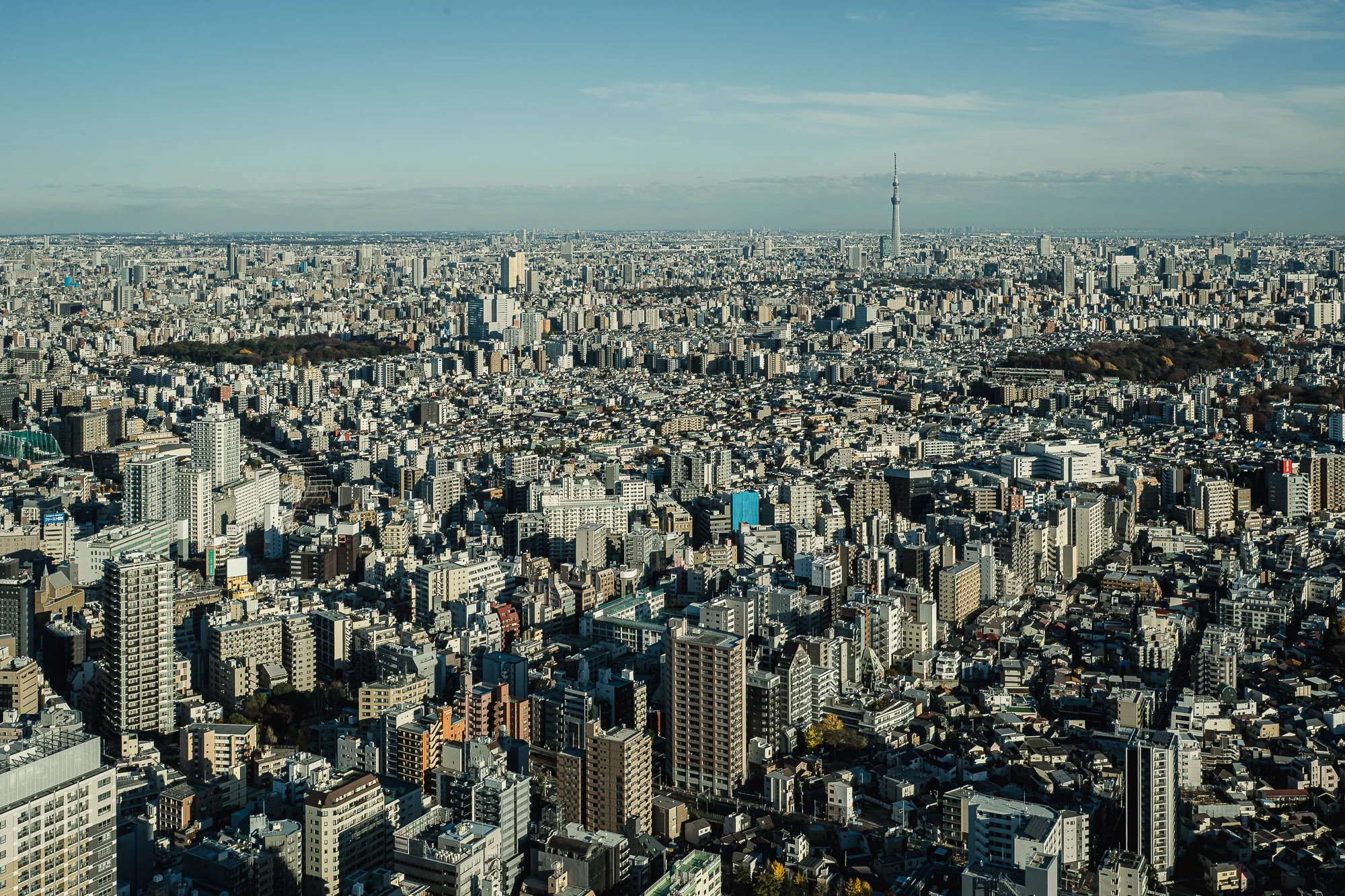
The image above was taken from one of the highest viewing points in Tokyo — about as close to a bird’s-eye view as you can get. A vast, sprawling metropolis of concrete, glass and steel, home to nearly 37 million people.
Despite the density, crime is low, the streets are clean, and people mostly keep to themselves. The city is designed with convenience in mind: trains are frequent and almost always on time; convenience stores are open 24 hours a day and live up to their name. You can buy a meal, print documents, pay bills, or even pick up event tickets.
And then there is city hall. Even this is, for the most part, orderly and efficient — though still fond of multiple printed copies of everything, and where the fax machine remains stubbornly alive.
Generally speaking, things work well.
So when people ask what it’s like living in Japan, I can say — hand on my heart — that it is, for the most part, quite easy. As long as you follow the civic rules and guidelines, everything simply works.
Until it doesn’t…
What follows is one such occasion — thankfully one of very few. A moment when expectations didn’t quite line up.
And it occurred, of all places at my local city hall.
It is a place designed to remove emotion from the room. Not a place to be enjoyed, it is a place designed to be efficient - a place to get in and out of as quickly as possible.
You take a number, and you wait. Conversations are quiet, procedural. Even frustration is expected to be communicated politely, if at all.
I was there for something forgettable — a tax bill, or maybe health insurance. The reason hardly matters. What matters is that someone noticed a mistake on my alien registration card, known affectionately by expats here as “The Gaijin Card.”
My middle name — William — had been misspelled. One “L” instead of two.
I was aware of it, and had been for some time. But I rarely used my middle name in English, and in katakana (the Japanese script used specifically for foreign names and words) the difference disappears - English spelling is usually seen as secondary to katakana. More importantly, I knew what correcting it would involve: forms, time and delays. It seemed easier to simply leave it alone.
Or so I thought...
They told me the card would need to be reissued and a new photograph would be required. I asked if they could reuse the one already on file. After all, the card was only a year old and I didn’t see the point of a new photo.
More importantly, I didn’t like the idea of being penalised - paying - for someone else’s mistake. This is in fact something of a personal philosophy: no matter how small the amount, if I don’t make the mistake in the first place, I don’t want to pay. It feels unjust and unwarranted. Petty? Maybe. But a personal philosophy is a personal philosophy.
However, they insisted.
We went back and forth. No raised voices. No overt anger, but frustration starting to show, on both sides.
Then, out of nowhere, the section manager appeared from the back.
He didn’t speak quietly. Unlike his subordinates, he didn’t even try to be polite, nor did he ask what had happened. He just proceeded to scold me — sharply, loudly — in front of a crowded waiting room. His tone made it clear this was no longer about paperwork. He made it clear I was the problem.
I felt my cheeks burn. Suddenly aware of how still everything and everyone else had become.
I wasn’t angry. I was embarrassed. Humiliated even, in a way I hadn’t felt since childhood.
I had taken the morning off work for this! Now I would need to take another morning off to return once the new card was ready.
Seeing no other choice, and realising it was me against a whole immovable system, I relented. I had the photo taken - practically throwing it at them on my way out. Something I regret doing now - but I was embarrassed, humiliated and defeated - and given that my attempts to speak in Japanese were falling on deaf ears, it was the only way I could think of to express my defiance and disgust at the whole thing.
Two weeks later, I reluctantly went back to collect the new card. Another morning off work.
There was another mistake. This time, my address.
To their credit though, before I could even refuse to pay for another photograph, they acknowledged the error. They told me it would be corrected without the need for a new photo.
Yet, it was another wasted trip that would require yet another morning off work…
Now, my boss was polite about it, but I could feel his patience thinning. Another form. Another visit. Another explanation that sounded increasingly implausible, even to me…
Now, on this third visit, my wife decided to accompany me. She must have sensed — correctly — that I might need some support this time. And since she was in a position to, she joined me at the city hall.
Third time lucky, right!?
Well, they also say that things happen in threes.
Yup. You’ve guessed it. The card was wrong again!
My surname this time. Harison, instead of Harrison.
I laughed!
My wife didn’t!
She didn’t attempt to soften her voice. She spoke directly to the section manager, in front of the waiting room - tables now turned.
She scolded him and his staff — incredulous that the same document could be issued incorrectly so many times, with so many people checking and re-checking the contents. She was far less forgiving than I was at having to deal with foreign names and addresses.
She pointedly demanded to know why each correction required another absence from work.
She demanded a letter of apology - I had never even heard of such a thing. The idea felt strange to me — formal, almost theatrical — but in the room, at that precise moment, it landed with immediate weight.
The tone and attitude of the city hall staff immediately shifted. The staff looked at eachother, uncertain how to respond. All eyes on their manager. The same person who had scolded me unceremoniously in this very room a month earlier. This time I noticed he was turning red. I would be lying if I said I didn’t feel even a tiny bit of glee.
But, my wife didn’t stop there.
She also demanded that the corrected card be delivered to our home. Neither of us was wasting any more of our time on this matter.
The atmosphere shifted again, and apologies came quickly. All the staff that had been handling - or mishandling - my gaijin card bowed in apology.
The very system that had seemed immovable a month earlier suddenly loosened and things started moving to an acceptable resolution, and they corrected the card without further ado.
What stayed with me wasn’t the apology, or even the delivery.
It was the feeling I had walking out of that building that first time — cheeks burning, alone in a crowded room — realising that following the rules wasn’t always enough. I had assumed that logic would carry the day.
It didn’t.
What carried weight was tone. Presence. Fluency in a language that had little to do with vocabulary and more to do with expectation.
At the time, I left feeling more like an outsider than I had ever felt.
Now, I see it differently.
Not as a battle won, or a system defeated — but as a lesson in how authority is negotiated here.
If it happened again, I would certainly stand differently. I would have different expectations.
And perhaps that is its own kind of belonging.
Sincerely,
Ross Harrison - A Tokyo-based photographer documenting a more authentic Japan beyond social media posts and postcards.