Letters from Tokyo #3 — 22 Years in Japan: What I Got Wrong (and Right)
When I first arrived in Japan in 2003, I thought I had some idea of what I was stepping into. I’d travelled, I’d read the guidebooks, I’d watched the films. I assumed living abroad was simply “life, but different” — familiar enough, just with new scenery.
What I didn’t understand was that Japan doesn’t just offer a different lifestyle.
It offers an entirely different logic!
And it took me years to realise how much of that logic I misunderstood at the start.
What I got wrong at first
I assumed politeness meant warmth. It doesn’t!
I assumed silence meant disinterest. It doesn’t!
I assumed efficiency meant simplicity. Unfortunately, it doesn’t…!
I thought I would eventually be able to “understand Japan” the way you understand a difficult piece of music — study it hard enough and eventually it reveals itself.
But it is not as easy as that. Japan isn’t a score you master.
It’s a relationship you grow into, unevenly and often awkwardly.
In those early weeks, everything still felt bright and possible. I was using my terrible Japanese with confidence, making friend (even if they were only surface-level), and convincing myself that enthusiasm would carry me wherever skill fell short. And for a while, that worked.
Then came the moment that punctured that early confidence.
A few weeks in, I walked into a McDonald’s near my apartment. I couldn’t read the menu, but the pictures were simple enough. I pointed at an item labelled “NEW” and asked, in what I know was perfectly correct Japanese:
“What kind of burger is this?”
The staff member froze.
Then, with a strained smile:
“Sorry, I don’t speak English.”
I tried again — slower, clearer — still in Japanese.
Another apology.
Another insistence she couldn’t speak English.
After several rounds of this, she suddenly switched into perfect English:
“Oh, it’s a chicken burger!”
It was a tiny misunderstanding.
But it knocked the wind out of me.
I’d been trying so hard to meet Japan halfway, and in that moment it felt like I hadn’t even taken a single step. I walked home with a heaviness I couldn’t shake. That almost insignificant encounter triggered my first real wave of culture shock — a deep, lingering homesickness that lasted months.
I stopped using Japanese.
I avoided unnecessary interactions.
I was suddenly terrified of feeling that exposed again.
It took a long time to recover from that.
And it was only the first of many lessons.
I spent the next few years missing entire layers of communication happening around me — body language, timing, hesitation, the weight of what stayed unspoken. I over-explained when brevity was expected. I filled silences that weren’t meant to be filled. I asked direct questions when an indirect answer would have been the more considerate path.
And every so often, the distance between cultures felt impossibly wide, almost as though the world was moving on without me.
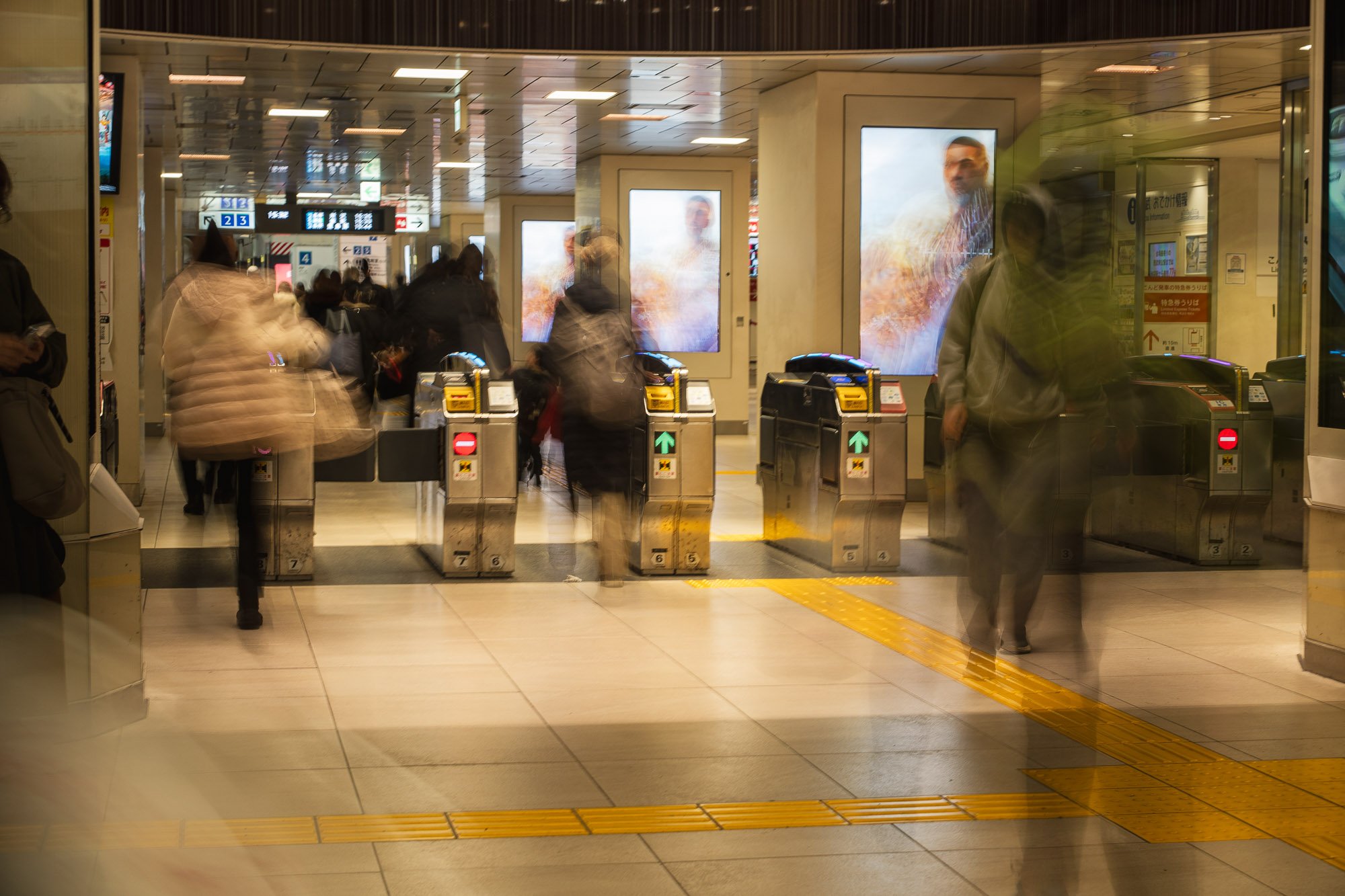
The lessons that came with time
The longer I lived here, the more I understood that belonging isn’t granted through fluency or years spent in-country. It’s built through small, consistent acts of paying attention.
Japan taught me patience — the quiet kind.
It taught me restraint — not everything needs your opinion.
It taught me to notice — really notice — how people move, decide, hesitate, and harmonise.
It also taught me that “efficiency” here doesn’t mean what I’d assumed.
I learned this through what I thought would be a simple address change at city hall. In my mind: a ten-minute errand. In reality: a pilgrimage from counter to counter, form to form, stamp to stamp.
Everyone worked quickly.
But the system wasn’t designed for quickness.
It was designed for correctness — for eliminating uncertainty, not for saving time.
That lesson resurfaces again and again through something as small as my own name.
Back home, my middle name — William — was optional at best. When I opened my first bank account in Japan, I left it out entirely, thinking nothing of it.
That tiny decision has haunted me for twenty-two years…!
Every renewal, every record update, every time I try to set up a recurring payment has carried the same friction (and no small amount of dread!): Japan expects your name to match exactly, everywhere. No improvisation. No rounding up or down. The logic is simple: systems work because everything aligns.
My name does not.
What felt harmless in week one became a recurring reminder that Japan’s foundations are built on precision — and even small misalignments echo for a very long time.
These weren’t just bureaucratic frustrations.
They were lessons in how Japan thinks, how it maintains order, and how deeply its systems trust consistency over convenience.
What I eventually got right
Over time, I listened more than I spoke. Admittedly more by necessity than design at first. I stopped trying to decode everything and started appreciating what I could understand.
I learned to get comfortable with ambiguity; to let certain mysteries stay mysterious.
And slowly — very slowly — Japan stopped feeling like a puzzle I was failing to solve and started feeling like a home whose edges didn’t need to be fully defined.
My life here began to make sense not because I mastered the culture, but because I allowed it to shape me in ways I didn’t anticipate.
Which is, I suppose, the part I never expected to get right.
Where I stand now
After twenty-two years, I still misunderstand things.
I still get cultural signals wrong. I still find myself surprised, softened, humbled, and at times, yes, embarrassed! But I’ve realised that this is the point. This is the relationship.
A long-term life in Japan isn’t a story of assimilation. It’s a story of adaptation, curiosity, humour, and resilience. What I got wrong taught me far more than what I got right.
And both have shaped the life I live now — a life I never could have imagined when I first stepped off the plane.
Sincerely,
Ross Harrison - A Tokyo-based photographer documenting a more authentic Japan beyond posts and postcards.
Letters from Tokyo is a personal writing series reflecting on life lived here.