Letters from Tokyo #13: Staying in the Conversation
日本語の重要な単語とその使い方を勉強して、日本語の会話をマスターしましょう。
“Nihongo no jūyō na tango to sono tsukaikata o benkyō shite, Nihongo no kaiwa o masutā shimashō.”
Translation: “Let’s study important Japanese words and how to use them, and master Japanese conversation.”
This was the promise of a CD-Rom language programme that I bought around 2002/2003 - just before moving to Japan.
Like most people preparing to move abroad, I hit the books hard, well, in this case, a CD-ROM. This was the very first Japanese sentence I ever learned. What followed was a series of common words and phrases to memorise, along with the occasional dialogue to study, and for around six to eight months, I spent at least two hours a day doing precisely that.
It all started well enough. The more words and phrases I learned, the more excited I became, imagining the opportunities and the life that awaited me in Japan. When I finally set foot here, I threw myself into every opportunity to use what I had learned, confident that each interaction would bring me closer to the fluency I was sure would eventually follow.
And then I met Ayako.
At the time, her English was a just little better than my Japanese, so I hit the books even harder, determined to catch up. But after we had been together for around two or three months, that all changed.
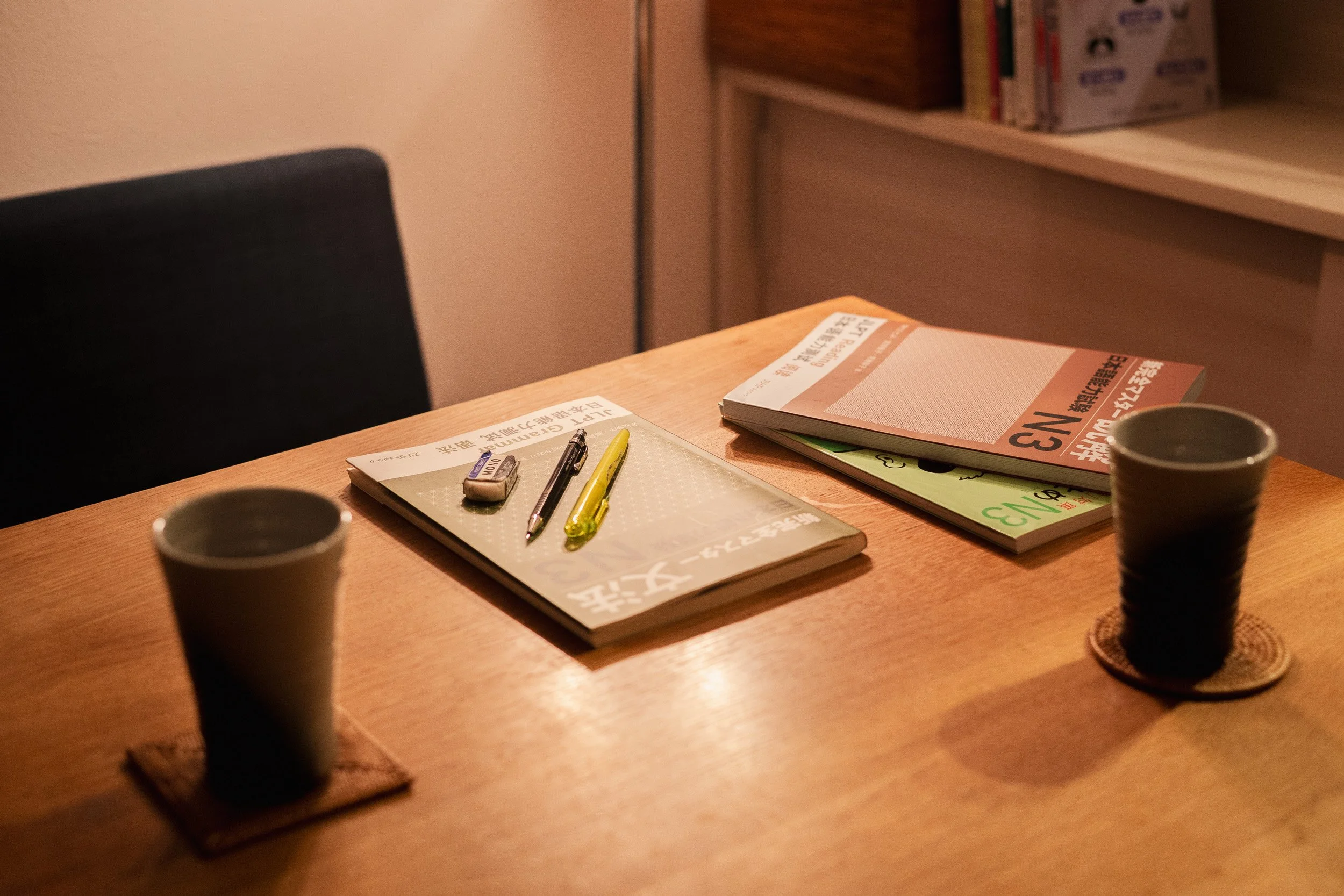
One afternoon, sitting at the table with my textbooks open, she uttered the fateful words:
“You don’t need to study Japanese,” she said. “I’ll practise English.”
“OK!” I replied, and closed the books.
They stayed closed for around ten years…
It was not as reckless as it sounds. I had not expected Japan to become my permanent home, and we had already talked about living in Britain one day. If one of us needed to become fluent in the other’s language, English seemed the more practical choice. I probably felt relieved, too. Learning Japanese was not easy, and Ayako had just given me permission to stop.
English became the language of our relationship. At first, misunderstandings were common and sometimes painful. Over time, as most couples do, we found ways to express what we meant and gradually built a relationship around our own English-Japanese hybrid, though it remained around 95% English.
Meanwhile, I learned just enough Japanese to live here. I could shop, travel and manage the ordinary transactions of daily life. As the years passed, familiar routines required less language, not more, and Ayako could handle whatever I couldn’t. And I soon discovered that life here could be lived with surprisingly little Japanese. The longer I stayed, the better I became at doing precisely that.
A common misperception about living abroad is that language will somehow be acquired through osmosis, as though twenty-three years in a country equals twenty-three years of its language. It does not. Being surrounded by Japanese is not the same as receiving comprehensible input. Nothing is slowed down or simplified simply because you are learning, and written Japanese remains largely inaccessible until you have overcome the seemingly insurmountable barrier of kanji.
In recent years, though, I have hit the books again and built a routine of daily study. More importantly, I began seeking out Japanese I could actually understand: graded readers, children’s stories and language apps pitched closer to my level. For the first time, much of the Japanese surrounding me started to become comprehensible. My progress has not been dramatic, but it has been real - even if I am sometimes the only one to notice.
On a good day, I can hold my own in a reasonably involved conversation with a butcher, discussing the best cut and amount of meat for a dish I want to cook. In fact, during one such recent conversation, the butcher commented on the relief he felt after hearing me speak “good” Japanese - he had been readying himself for a difficult interaction using his long-forgotten junior high school English.
But then just a week after that interaction with the butcher, I stood at a hotel counter in Matsumoto, with my father beside me, unable to make a simple request - one that I had made a hundred times before - asking the receptionist to hold our bags for a few extra hours while we did a little more sightseeing before heading home.
She pieced together my meaning well enough and nothing went wrong. My father even laughed it off as he had also experienced something similar trying to speak French. He thought little more about it.
But I did…
Ironically, I speak much more Japanese now than when I first arrived. But back then, I used it more freely, and certainly with more confidence! In those days, every mistake felt like part of learning, but now, after twenty-three years, it can feel like evidence that I really should be much further along.
This inconsistency no longer surprises me. The greater problem is what happens when the stakes are higher.
What I have lost is not simply fluency, but authority. I can sense that something is not right with a bill, a bank statement or an official letter without having the language to challenge it properly. In those moments, it is not only the words that go missing, but also the confidence I take for granted in English.
And so I do what has become almost automatic. I ask Ayako to deal with it.
It is easy to overlook how normal this has become. Japan is her country; Japanese is her first language. Married couples divide responsibilities according to their strengths all the time. But this division is not equal: Ayako can function independently in English when she needs to. I cannot always do the equivalent in Japanese, particularly when something complicated, official or important is involved.
The decision we made at her table all those years ago did more than determine which language we would speak at home. Gradually, and without either of us consciously deciding it, it made her responsible for navigating parts of my life that I really should be able to navigate myself.
Opportunities to speak Japanese are surprisingly scarce. English remains the language of my marriage and much of my work, while daily routines rarely require me to venture beyond familiar ground. Study has improved my comprehension, but understanding more Japanese does not automatically make it easier to speak.
It is also true that I spend too long waiting for conversation opportunities rather than creating them. Speaking requires taking risks, making mistakes and accepting that things may go wrong. It means asking questions, admitting when I do not understand and resisting the temptation to withdraw too soon.
Ayako and I sometimes talk about that afternoon in her apartment. We both regret it a little, though regret can make an old choice appear more decisive than it really was; there is no guarantee that I would have studied diligently for the next twenty years had those books remained open. Neither of us knew that Japan would become my home, or that the language we chose for our relationship would eventually shape the balance of independence within it.
I cannot return to that table and choose differently. Nor do I need perfect Japanese. But I do need to keep studying the words and how to use them. Only then might I get closer to mastering Japanese conversation in the way my younger self imagined.
頑張ります!💪🏻
Sincerely,
Ross Harrison - A Tokyo-based photographer documenting a more authentic Japan beyond social media posts and postcards.